
On Richard Lovelace (Part One)
At Liberty in Chains
I
On 19 April, 1642, at a meeting of the Kent quarter sessions at Maidstone, the threshold of the courtroom was intruded upon, its proceedings assailed, and the current speaker, a Mr Thomas Blount, interrupted by a group of young men, lately from a tavern, who wished to halt the matter under discussion from being sanctioned. The object of both the court’s efforts and the young men’s ire was a petition — or rather, a counter-petition — poised in defence of Parliament’s escalating confrontations with the King. Keeping their hats firmly upon their heads, in direct contempt of the court, the leader of these bellicose intruders then stepped forward, took hold of the petition (perhaps even skewering it upon his sword) before raising it above his head and slicing it to myriad pieces.
The purpose behind this act was not mere posturing. Only the month previous, at the Maidstone Assizes, a petition was drafted which aimed at a redress of grievance, particularly as it pertained to the latterly passed Militia ‘Ordinance’, a temporary legal instrument that did not require the assent of the King — who was, conveniently, visiting Scotland at the time — and which Parliament subsequently sought to enforce. Also among the demands were: protections for ‘the Solemne Litturgy of the Church of England’ — to wit, The Book of Common Prayer — the restitution of the twenty-two Bishops excluded from the House of Lords under the 1640 Clergy Act, and the suppression of dissenting pamphlets, sermons, and mechanic preachings. There were other demands, many of them similar in aim to these. However, Parliament, by this time increasingly both paranoid and, having tasted the sweet exercise of its own presumptuous powers, careless, had the drafters and promoters of this document, Sir Edward Dering, Sir Roger Twysden, Sir George Strode, and Richard Spencer called to parliament and detained. Copies of the petition were then ordered to be burned by ‘the hands of the common hangman’ at Westminster, Smithfield, and Cheapside.
The question as to why Parliament, by now known as the ‘Junto’ and lead by the puritanical John Pym, should have acted so rashly is two-fold: first, the aims of the petition were in contradiction to the direction in which Parliamentary power was then proceeding, both ecclesiastically and in its desire to rule by the power of Ordinances; and second, it did so in manners both moderate and judicious — in other words, it appealed to the powers circumscribed by convention and law.
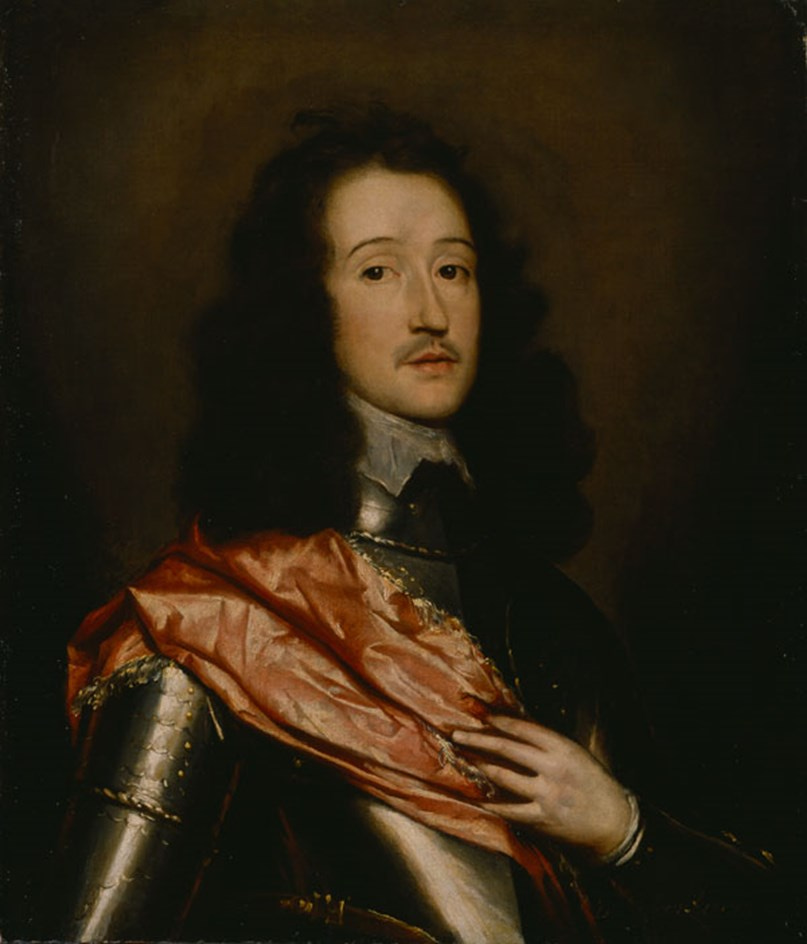
The young man who had disrupted the court on the 19th had done so in direct defiance of the suppression of this petition, and on the 29th lead a larger procession, along with Sir William Boteler, to Blackheath, after which they went and presented the same signed petition again, only the next day, to a sitting of the Commons. The two men were then promptly imprisoned, Boteler in the Fleet, and the other to the Gatehouse. This latter, still only twenty-five, and who had already fought for the King in the Bishop’s wars, was a Richard Lovelace, and represented in his chief aim, that is poetry, that which was best in the cause for which its proponents have come down to us with all the spirit, taste, perhaps even the beauty, of their lost illusions, and indeed with their name — the Cavaliers.
II
For seven weeks, Lovelace lived with the latticed shadows of the prison bars cast upon his face and mind. All the while a storm was raging outside his window, the nature of which it is unlikely he was not cognisant. For it was just a short walk from where he lay sequestered in the Gatehouse to Westminster Abbey that Parliament, sitting in St Stephen’s chapel, emboldened no doubt by the King’s recent failure to secure the strategic town of Hull, was preparing its nineteen ‘propositions’, a set of radical terms by which ‘The entire executive and judiciary were to be subject to Parliamentary control, with judges and officers no longer dismissible by the king. Religion was to be thoroughly reformed by forthcoming Assembly of Divines. The children of Catholics were to be educated by Protestants, while Parliament was to control both the education and the marriages of the royal offspring,’ (Healey1 p.167).
As the war between King and Parliament became ever more imminent, and perhaps in overhearing, either by gossip, or by the chattering members passing in the street beneath his quarters, of the increasingly parlous state of the country’s maintenance of order, Lovelace nonetheless turned his mind from the immediate squall from without, and like the sailor waiting out a perilous storm flailing on the other side of his porthole, turned his mind inward, in his case to poetry, producing one of his finest lyrics, and perhaps even the most notable prison poem in the language: ‘To Althea, From Prison’. It would not be the last time he found the muse on the inside of a locked door. Indeed, as Gerald Hammond2 has pointed out, ‘The rest of the volume [Jucasta, which collected all his poems up to 1648-9] is shot through with images of imprisonment and hiding away, not only in those poems which claim actually to derive from Lovelace’s two spells of incarceration, but in poems which probably antedate the civil war.’ It seems then that the young poet may well have concurred with Hamlet when he said of the world that it was a prison, and ‘A goodly one; in which there are many confines, / wards and dungeons’.
In her reading of ‘To Althea, From Prison’, Susan Alice Clarke makes clear that ‘with a few exceptions, criticism of [the poem] focused on the extent to which the text represents stoic and/or epicurean tendencies in cavalier writing,’3 and that at the centre of all readings of this poem is the fundamental ambiguity presented therein by a paradoxical relationship between freedom and confinement. Many subsequent readings have relied on a stoical rendering of the speaker’s resolve, relating the paradox, resolved in its final stanza, to the power of the mind to cavort, dalliance, even drink to the King’s health, despite whatever immediate impediments disrupt the body. Clarke makes great hay with more immediate textual precursors (to which I all compel you) while others present perhaps the most famous template of Christian prison stoicism, Boethius, for a model of the poem’s undercurrents. I am following a slightly different line here, and not only for variety, in which the same paradox resolves itself in a more broadly political manner.
For instance, in the opening stanza, Lovelace writes:
When Love with unconfinèd wings
Hovers within my Gates,
And my divine Althea brings
To whisper at the Grates;
When I lie tangled in her hair,
And fettered to her eye,
The Gods that wanton in the Air,
Know no such Liberty.
Each stanza sets up this juxtaposition between the poet’s immediate circumstance within the Gatehouse prison and the freedom of his thoughts and sentiments to roam. Envisaged here is the visitation of his Althea’s Love, which though cannot literally spring him from gaol, grants him such Liberty as even the Gods are ignorant. This is a fine romantic conceit, but there is a further, perhaps more troubling instability, which is that in order for the poet to be, as it were, freed, he is necessarily imprisoned by his beloved. What else could ‘tangled in her hair’ and ‘fettered to her eye’ mean, but to suggest by exchanging one kind of confinement for another he finds a different set of circumstances? In this case, ‘Liberty’.
While all critics agree the poem’s final stanza, which begins with these immortal lines,
Stone walls doe not a prison make,
Nor iron bars a cage ;
Mindes innocent and quiet take
That for an hermitage
does make explicit the reconciliation of the paradox, it nonetheless throws up another, more subtle. If Stone walls do not a prison make what, exactly, does? If, as Hammond points out, that Lovelace seems to have been preoccupied with this image of confinement before he had himself in fact been physically imprisoned, we are bound to ask the question whether the real ‘prison’ is in fact, as presented in this stanza, his beloved’s claim on him. Indeed, there is an anxiety latent in this and (as we shall see) other of Lovelace’s poems, that — as I previously pointed out by use of that line of Hamlet’s — the whole world is a prison, a place of claims upon one’s person and soul, and where such claims, whether political, ecclesiastic, romantic, economic, etc. are the stone walls, fetters, and bars of the ‘Goodly’ prison. The object, then, is to find oneself within such boundaries as are to produce the circumstances commensurate with one’s desires for society; to find, as it were, one’s Althea. Indeed, when such a thing occurs, a different name attaches itself to these set of confines, to these stone walls: we call it Home.
There is, however, an unspoken anxiety here, almost a catch in the poet’s throat, regarding the alternative which is his beloved’s failure to visit his thoughts in consummation, but instead passing by in indifference. What if his beloved had no claim on him? This strikes at the heart of the more personal aspects of this poem and the wider political atmosphere. For, in the third stanza, Lovelace makes clear his allegiance to the King by stating how by singing ‘like committed linnets’ to the ‘Mercy, Majesty / And glories of my King’, we are then perforce made to compare the position of the King as the, as it were, ‘visiting’ party, with that of Althea’s in the first, and must conclude that he too is imprisoned by his King, before posing the same question: what if the King failed to ‘visit’? Necessarily, based on the structure of the poem’s conceit, in which each stanza offers this same ‘visitation’ but with a substituted object — Althea, Wine, the King — and thus, an anxiety over their potential emotional absence, we are presented a vision of a man, indeed, a land, without Love (sexually charge, ‘unconfinéd wings’ and the illusive pun regarding ‘gates’), without wine, and without Kingship. Indeed, given we are encouraged by the very structure of the poem to substitute each of these with one another, it is clearly attempting to show the intrinsic relationship between all three.
Charles I, for instance, after reissuing his father’s Book of Sports in 1633, which licensed sports and recreations on Holy Days, placed himself and the established church firmly against the increasingly Puritanical forces of society, which desired local traditions (many pagan, see Lovelace’s reference to ‘Gods’) to be ceased and Sunday to be preserved purely for improving activities. In London, where taverns, bear-baiting (actually prohibited in the Book of Sports), brothels, and plays had all been on offer, cheek-by-jowl, and at court, where sans bear baiting, much the same things occurred in (or perhaps out of) silks rather than wools, we see a world in which Kingly authority, and the freedom to drink and be merry, are related to the very form of love which Lovelace addresses to the recipient of the poem, that is ‘To Althea’.
To our contemporary sensibilities, it may seem unsettling that on either side of the Civil War were factions which, on the one side, desired to protect freedom to exercise oneself in pleasures — not all purely corporeal; for, as this poem makes clear, their effects do not strictly vanish when removed, just as Kingship wouldn’t, as Parliament would come to understand in 1660 — and yet nonetheless wedded itself to the idea of an established church that required the suppression of dissent; and on the other, a faction desirous of religious toleration for all dissenting orders (no Catholics) while simultaneously shutting down all theatres, curtailing taverns, and ending all local customs. Today the freedoms of dissent and the license to enjoy oneself are so entirely wedded that it is disconcerting to see the two divorced from, and opposed to, one another.
Whether you hold the Social Contract view of Hobbes or Locke, or the more Conservative, as of Clarendon’s critique of Hobbes, nevertheless there is no doubt that Freedom, as envisaged without laws, without boundaries of social mores and custom, is merely the freedom to perish. To have no confinement, no restraining influence, to have no claim on one's self in manners delineated here, is in fact the total restriction of the soul. It offers no anchor, no tether, and leaves one merely floating, ready always to be carried off by the weft and current of the passing moment, leaving a man of no shape but that which is made for him by the very present — always conditional, always negotiable — indeed, rendering that which is most irreducible to fungible man.
The question then becomes what boundaries and which laws, and this, as expressed in the poem, is answered by the nature of the society in which you wish to live. Puritans would no doubt find their liberties within gaol gifted by their moral conscience, by their absolute faith. See how distinct the two visions appear by comparing the sensibility of Lovelace and Bunyan in his Pilgrim’s Progress, also written in prison. By taking the purely stoic reading of this poem then to its conclusion, one could argue that, since Love (of this sort), Kingship, and wine, are all just as lovingly savoured when divorced from him, that Lovelace needn’t present a need to defend them in the realm of actuality. On this basis, what need is there of a civil war? One and all, like Simeon Stylites, should have found their pillars and remained aloof from a world which would cease to exist, for its former inhabitants would now all live above ground. No, it would do a disservice to take this churlish view of the poem; for that anxiety, which lingers behind each mention of these ‘visitors’, is the fear they may no longer be around to visit, and puts paid to the idea that however superficially grounded in earthly delights its expression is, it is in fact ethereal. This is actually revealed very simply. The consolation of one’s love, either in adversity or distance, seems only really of any use when one is certain of it being requited. The consolation comes from loving one who loves you back, just as the consolation of a tavern is knowing it will serve you drink when you arrive. In other words, Lovelace, however much he presents an even nerve in the face of adversity, nevertheless relies on these things to exist somewhere, to provide hope that there can be a consummation of the desires for such things, however tarried, in the flesh, and which in this case may require fighting for.
And so, beneath his prison window, either by quill or by mind, he committed these words, and as the rumblings of Parliament across the way moved ever closer to war with the King, birthed a poem which not only reiterated his loyalties, but covertly voiced the necessity of victory; for however long the sweet Freedom of Althea, Wine, and the King could last in absence, he knew it would not be forever. That is why, however much the overt tone of this poem is stoical, beneath it, and beneath even the anxieties I have pointed out, is a lion’s roar.
III
Lovelace was bailed on 17 June, four days before The King’s refutation to the Nineteen Propositions was read in Parliament, which, in denying all its demands, concluded: ‘For all these reasons to all these demands our answer is, Nolumus Leges Angliae mutari [We are unwilling to change the laws of England]’4. This was a coup. As has been pointed out5, over the previous year or so, Royalists had increasingly succeeded in forming an opposing block in Parliament, alongside the influence of such advisors as Sir John Colepepper, Lucius Cary, Viscount Falkland — both of whom drafted the reply — and, perhaps most important, Edward Hyde, the future Lord Clarendon. These men, by no means uncritical servants of the King, aimed both not only to curtail the caprice of the Commons but to temper the Monarch’s excesses. Part of this moderation was by no means uncontroversial. For instance, the refutation seems to suggest Charles accepting his position as a constituent part of the estates in Parliament, which would necessitate a tacit acceptance of the expulsion of the Lords Spiritual. Nevertheless, due to the influence of these men, Charles I had come to understand and accept his appropriate place in the constitutional model of English governance.
As Healey states:
At heart, the Royalists were claiming that they were defenders of the ancient constitution: the Parliamentarians were the ones trying to make innovations in government. It was a palpable hit: the opposition had moved from trying in 1640 to remove ‘illegal’ aspects to Charles’s rule to making lasting reforms to the government, most particularly by claiming parliamentary control of the executive and the armed forces.
Healey, p.168.
When the King raised the royal standard at Nottingham on 22nd August, in effect marking a declaration of war, Lovelace was still in the Southeast. He would not fight for the King again, either now or for Charles II in the later resurgence of hostilities. As Clarke makes a reasonable case for in her study, he remained in and around Kent in order that his land would not be sequestered as an enemy of Parliament, and is likely instead to have supported the King’s cause surreptitiously, maybe ‘involved in hiding royalist plate and vestments for transportation to the Low Countries at his childhood home on the river, although this could never be proved. If so, his actions may indicate the start of a long-term, covert involvement in the royalist war effort, in which guise he emerges in 1648 and again in 1654,’ (Clarke p.59-60). It is worth pointing out however, that he may well have fought in Europe, being wounded at the siege of Dunkirk in 1646, leading a company there.
We will end this first part, then, by looking briefly at a poem Lovelace wrote earlier in his life, before he could have foreseen himself imposing upon the Commons, in the imperious manner in which he did, the demands of the men of his county, and being banged up for it; certainly before he could have foreseen open warfare between Parliament and Loyalists. Yet to prove Hammond’s point, that Lovelace seems preoccupied with the twin themes of imprisonment and freedom — and the sometimes elided meanings of both — we can return to ‘To Lucasta, Going to the Wars’, perhaps his earliest extant lyric, and one of his most beautiful.
It was written and refers directly to his experience at the age of 22 going off to fight the Scottish Covenanters in the Bishops’ Wars. In the opening stanza we witness the same themes, and indeed the same interplay between them:
Tell me not (Sweet) I am unkind,
That from the nunnery
Of thy chaste breast and quiet mind
To war and arms I fly.
Again we have the confinement of a Lover’s (in this case named Lucasta) affections. Yet here it is presented not as a key — the freeing element which, in a rhetorical manoeuvre, unlocks the poet from his immediate impediments. Here, the love is a confinement, but it resembles more the stone walls and iron bars in its position in this thematic relationship, with the call of war the freeing element. Clarke observes, ‘The young man, excited at the prospect of going to war for the first time, leaves his chaste mistress safe in her fictive nunnery,’ (Clarke, p.129), but I think this is a misreading. Lovelace refers to ‘the nunnery of thy chaste breast’ of his lover, ie. the nunnery is her, or rather her claim on him, and he the nun. The war and arms to which he flees refer to that longstanding fact, which belies a deep and perhaps unsettling truth, which nonetheless appeals to the highest of the masculine virtues, as well as its lowest impulses. It is the spring of Chivalry, the font of honour, the root of nobility and self-sacrifice — the sacrifice of one’s life to a noble cause. The first stirrings of all these within a young man’s breast are born in the games of knights played on the fields of youth; and, however much they be suppressed with time, they nonetheless resurge with the breath of freedom. Yes, sad to say, war is man’s mistress — a cruel one, no doubt — and like the siren, lures him with sweet ideals before drowning him in its brutal grasp.
It is, then, rather fitting that this is a young man’s poem, which captures the spirit of that ideal in its first full blush. But like ‘To Althea, from Prison’, it is not quite so simple.
Yet this inconstancy is such
As you too shall adore;
I could not love thee (Dear) so much,
Lov’d I not Honour more.
This third and final stanza, like the final stanza of the later poem, aims to reconcile two competing themes: tempering his mistress’s dissatisfaction and potential sadness (whether at his departure, or the happy tones with which he communicates this fact) to his call to arms by appealing to the wider concept of honour, which can be as equally applied to the role of Lover and Warrior, and in this case warrior of the King. The lover then should want an honourable man, both in his vows of marriage, and in his vows of towards the King. The wry smile, which peers out from between those final two lines, has too the young man’s raw sense of jest: that the wielding of the sword of battle as well as that of the bedchamber is not a completely disconnected activity.
In part two, we will explore how Lovelace came to reconcile himself to Royalist defeat and the King’s execution by Parliament, the further maturing of his themes of confinement and freedom, inaction and resistance, and, despite his continued loyalty to it, his reservations regarding the Royalist cause. For the breath of youth and summer, which shines on through even his prison song to Althea, in his later work cools, becomes imbued with winter. The wine imbibed meets a more measured lip, and the daisy becomes a frosted rose.
Throughout this essay I am indebted to, among others, the work done in her Doctoral Thesis, ‘Richard Lovelace: Royalist Poetry in Context, 1639–1649’, by Susan Alice Clarke. Here, with great alacrity and attention to detail, Clarke synthesises the varied strands of textual and interpretive scholarship, as well as elucidating the somewhat obscure biography of its subject. Gerald Hammond’s essay/speech on Lovelace is also exemplary, and I urge all those interested to consult both for readings of Lovelace’s poems.
As for editions of Lovelace’s Poems, a free edition, published in 1864 and edited by W. Carew Hazlitt, is available here.
Healey, Jonathan. 2023. The Blazing World: A New History of Revolutionary England. Bloomsbury Publishing.
Hammond, Gerald. ‘Richard Lovelace and the Uses of Obscurity’, Chatterton Lecture of Poetry, read 23rd May 1985.
Clarke, Susan Alice. 2010. ‘Richard Lovelace: Royalist Poetry in Context, 1639–1649’, The Australian National University, p.167.
‘The emergence of moderate royalism, driven as it was by a fear of the people, had helped push the Junto towards a more direct appeal to these people,’ Healey, p154.